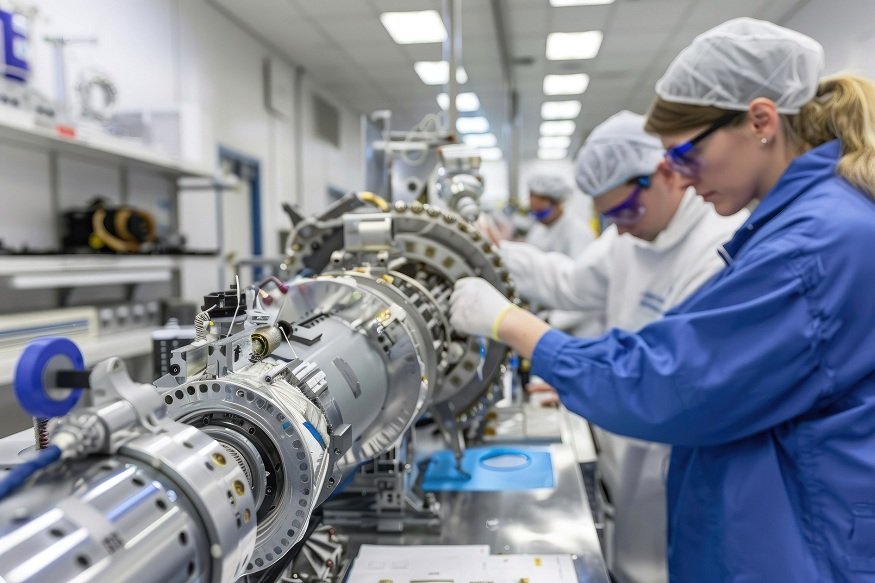
Fifty years ago, walking into an aircraft plant meant you’d hear it instantly. Those massive hangars were filled with the sound of rivet guns from dawn till dusk. That soundtrack has mostly disappeared. Aircraft assembly looks nothing like it used to. Today’s workers operate computer terminals and oversee robots that join airplane parts with heat, pressure, and chemical bonds instead of metal fasteners.
The Old Ways Are Fading Fast
Rivets built aviation. Every DC-3 that flew cargo over the Himalayas had millions of them. So did the 747s that made international travel affordable for ordinary people. A single jumbo jet contains roughly three million rivets, each one individually installed.
Read More: How Weight Reduction Translates Into Real-World Performance Gains
But here’s the thing about rivets. They’re heavy. Really heavy. Furthermore, they create holes in the materials they are joining. This is counterproductive if your goal is to create something sturdy. Installing them takes ages. You drill a hole. Clean up the metal shavings. Insert the rivet. Hammer or squeeze it into place. Repeat three million times. Aircraft manufacturers started questioning whether all those holes and all that extra metal made sense anymore. Turns out, they didn’t.
Composite Materials Change Everything
Carbon fiber changed the game completely. When carbon fibers are combined with appropriate resins, a remarkable material is created. Even though it’s lighter than aluminum, this material is more resistant to pressure. Half the weight of a Boeing 787 is comprised of these composite materials. The Airbus A350 took it even further. Drilling holes through carbon fiber is like cutting through a rope. You damage the very fibers that give it strength. Engineers had to rethink everything they knew about joining airplane parts together. The solution came from chemistry labs, not machine shops.
The Rise of Structural Adhesives
Forget everything you know about glue from arts and crafts class. Aerospace adhesives create molecular bonds that spread forces across entire surfaces. A riveted joint concentrates all its stress at specific points. An adhesive bond shares the load everywhere. Temperature and pressure transform these materials into something extraordinary. Axiom Materials stands out as an epoxy film adhesive supplier for aerospace composites. They provide materials that enable manufacturers to create joints stronger than the components they connect. When heated to the proper temperature and subjected to the correct pressure, chemical reactions take place that permanently bond everything.
What really excites engineers? You can bond completely different materials now. Carbon fiber sticks to titanium. Aluminum bonds with specialized plastics. Try doing that with a rivet. These hybrid structures allow designers to integrate the optimal characteristics of each material precisely where they are required.
Automation Takes Flight
Robots transformed aircraft assembly lines over the past decade. Automated machines lay down composite tape in patterns so precise they look like abstract art. Lasers weld metals without anyone touching them. AI-powered cameras can detect flaws invisible to the human eye.
Read More: From Concept to Cabin: The Material Choices Behind Modern Aircraft
While speed is important, consistent effort is even more crucial. A person installing rivets all day gets tired. Their accuracy drops after lunch. Their mind wanders during the thousandth repetition. Robots never experience bad days. Each component is positioned with extreme precision, adhering to tolerances as fine as fractions of a millimeter.
Conclusion
Aviation stands at a turning point. The methods that carried us through the jet age still work, but better options keep appearing. Lightweight composites replace heavy metals. Chemical bonds are now used instead of mechanical fasteners. Automated machinery now performs repetitive tasks. With every upgrade, planes are getting lighter. They are getting more durable and save more fuel. Those three million rivets in a 747 told one story about how we build flying machines. The invisible bonds holding tomorrow’s aircraft together will tell a completely different one.